

Central and Eastern Iowa homes possess a unique architectural heritage that defines our region. The bungalows of Des Moines’s Beaverdale neighborhood, the Victorian-era two-story houses in Iowa City, and the brick workers’ cottages of Cedar Rapids. The electrical systems inside them, though, are a different story. A home wired in 1958 was not designed to run a 50-amp EV charger, a smart panel, a modern kitchen, and a home office simultaneously. When the system can’t keep up, you risk outages and potentially an electrical fire.
At Custom Electrical, we rewire residential properties across Central and Eastern Iowa, from the Des Moines metro through the Creative Corridor to the Cedar Valley. Here is an honest look at how the electrical rewiring process works, what a rewire costs in 2026, and what you need to know before starting.
The Five Stages of a Home Rewire
1. Load Calculation and System Design
Before any wire is pulled, we calculate your home’s total electrical demand. In 2026, that means accounting for EV charging (typically a dedicated 50-amp, 240V circuit), smart appliances, HVAC equipment, and high-draw areas like kitchens and home offices. This step determines whether you need a 200-amp or 400-amp service upgrade — and it prevents undersizing a system that will be in your walls for the next 40 years.
2. Pathfinding and Rough-In
Technicians map the most efficient cable routes through your home’s structure, through attics, crawlspaces, and unfinished basements where possible, through walls where necessary.
We pull new NM-B (non-metallic sheathed) copper cable to replace your current systems, whether that’s knob-and-tube, aluminum branch wiring, or cloth-wrapped Romex from the 1960s.
3. Service Panel Upgrade
A full rewire almost always requires a new service panel. Most homes use a 200-amp panel ($2,800–$4,500 installed), which handles modern loads. Larger homes with detached garages, shops, or EV infrastructure often step up to 400-amp service, which runs $5,500–$8,000 installed, depending on utility coordination and the distance from the meter to the panel.
4. Device and Trim Installation
Once the rough-in is complete, we install tamper-resistant receptacles, switches, and all required GFCI and AFCI protection.
Dedicated circuits get their proper outlets — a 240V 14-50 receptacle for an EV charger, a 20-amp isolated circuit for a home office, a 20-amp GFCI for each kitchen counter run. This is the stage where the work becomes visible.
5. Inspection and Sign-Off
Every rewire in Iowa requires a licensed electrical inspection. We coordinate directly with your local jurisdiction — whether that’s Polk County, Linn County, Johnson County, or a smaller municipality with its own inspection office — and walk through the completed work with the inspector.
You receive documentation confirming the home meets the 2026 National Electrical Code, which your insurance carrier will want on file.
Realistic Rewiring Timelines by Home Type
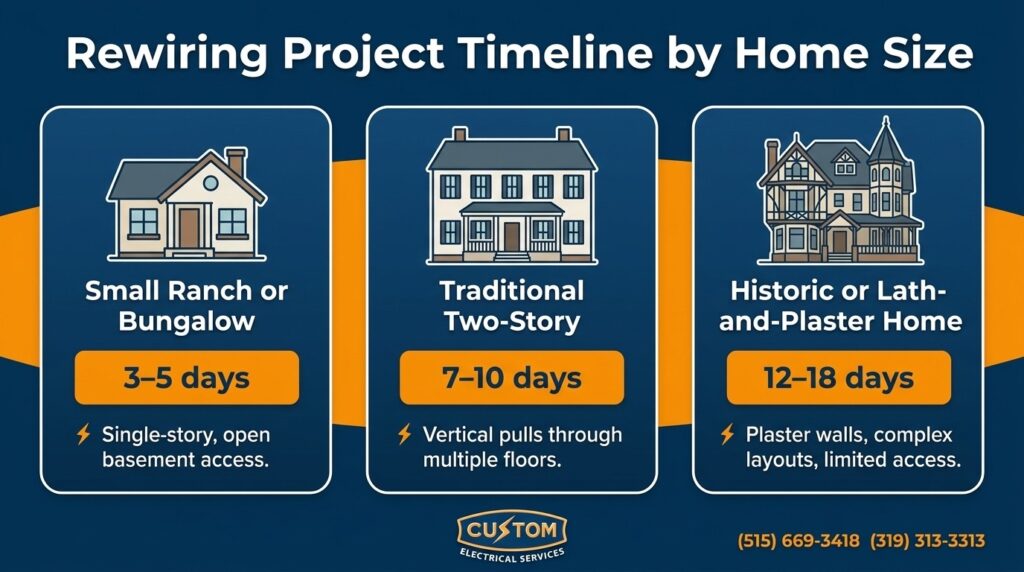
The single biggest variable in timeline — and cost — is wall material. Drywall can be opened and patched cleanly. Lath-and-plaster requires significantly more time to penetrate without causing collateral damage, and the finish work afterward is more involved.
2026 Pricing: What a Rewire Actually Costs in Iowa
Pricing in Central and Eastern Iowa reflects two realities: copper and labor costs remain elevated from 2024–2025 supply chain conditions, and the age of Iowa’s housing stock means more complex access situations than newer markets face.
Rewiring Project Price By Home Size
| Home Size | Price Range | Primary Cost Drivers |
| 1,000–1,500 sq. ft. | $6,500–$9,500 | Straightforward layouts, drywall construction |
| 1,600–2,500 sq. ft. | $10,000–$16,000 | Multiple dedicated circuits for kitchens and baths |
| 2,600–4,000 sq. ft. | $17,000–$28,000+ | Large footprints, high-end fixtures, panel complexity |
As a general benchmark, most homes fall between $3.50 and $8.00 per square foot — with lath-and-plaster homes and those requiring significant access work landing at the higher end, and straightforward ranch-style homes with open basements landing near the lower end.
Rewiring Project Component Pricing
| Electrical Component or Service | Estimated Investment (2026) |
| 200-Amp Main Service Panel Replacement | $2,800 – $4,500 |
| 400-Amp Service Upgrade | $5,500 – $8,000 |
| Rewiring per Device (Outlet or Switch) | $180 – $260 |
| Dedicated 240V Circuit (EV Charger, Dryer, Range) | $750 – $1,200 |
| Outdoor Emergency Disconnect (2026 Code Required) | $600 – $900 |
| GFCI Outlet Installation (Kitchen, Bath, Exterior) | $140 – $220 per location |
| Smoke/CO Detector Circuit Installation | $85 – $140 per location |
| Permit Fee (Varies by Iowa Jurisdiction) | $150 – $450 |
What Iowa’s 2026 Electrical Code Requires
Iowa follows the National Electrical Code, and local jurisdictions enforce it with varying emphasis. Here are the requirements that come up on virtually every rewire we do.
Outdoor Emergency Disconnect
Required on all residential services as of the 2026 NEC cycle. This gives firefighters the ability to de-energize a home from outside without entering a burning structure. It is not optional, and it is inspected.
AFCI Protection
Arc-fault circuit interrupters are now required for nearly all living area circuits — bedrooms, living rooms, hallways, dining rooms. AFCI breakers detect dangerous electrical arcs that standard breakers miss, and they are the primary reason new-construction fires from wiring faults have declined substantially over the past decade.
GFCI Protection
Ground-fault protection is required at all outlets within 6 feet of a water source: kitchens, bathrooms, garages, basements, and all exterior outlets. Each one of these gets tested before inspection.
Grounding
Iowa’s soil composition varies considerably from the loam-rich farmland north of Des Moines to the rockier terrain in areas of Eastern Iowa. Where soil conductivity is a concern, we install two 8-foot copper-clad ground rods to ensure the grounding system meets resistance requirements.
How to Reduce Your Total Rewiring Cost
Combine with open-wall work.
If a kitchen remodel, bathroom renovation, or basement finish is in your plans, schedule the rewire concurrently. Access accounts for a significant portion of labor cost — when walls are already open, that cost drops considerably.
Prepare access points.
Clearing furniture away from walls, emptying closets, and making sure attic and crawlspace hatches are accessible before the crew arrives reduces billable time directly.
Phase by priority.
If a full rewire isn’t feasible in one project, we can address the highest-risk areas first — the service panel, the kitchen, and any identified knob-and-tube runs near insulation — and schedule remaining rooms in a second phase.
Check utility incentives.
MidAmerican Energy and Alliant Energy both offer rebate programs in 2026 for qualifying smart panel installations and energy-efficiency upgrades. These don’t offset a rewire entirely, but they can reduce net cost on the panel portion of the project by $200–$600, depending on the program.
Frequently Asked Questions About Iowa Rewiring Costs
Do I need to move out during the project?
In almost all cases, no. We work in sections, ensuring at least the kitchen and one bedroom have live power at the end of every working day. We use floor protection and dust containment throughout. For homes with young children or pets, we can structure the schedule around their specific needs.
Does homeowners’ insurance cover rewiring?
Not proactively — insurance is designed to cover damage, not upgrades. However, many Iowa carriers now require homeowners to replace knob-and-tube or aluminum branch wiring to maintain coverage. In that context, the rewire is the cost of keeping your policy active. Once the work is complete, we provide full documentation for your insurer, and most homeowners see a meaningful reduction in their annual premium because electrical fire risk drops substantially with a modern system.
Why is knob-and-tube wiring still a problem in 2026?
Two reasons. First, it’s ungrounded — there is no safe path for fault current to travel, which means a wiring fault has nowhere to go except through whatever it contacts. Second, the cloth insulation on these wires was designed to dissipate heat into open air. When modern insulation was added to Iowa attics and walls over the decades, it trapped heat around those wires instead. The combination of degraded insulation and trapped heat is a reliable recipe for a fire. If your home has knob-and-tube, that system should be replaced.
Put 30 Years of Rewiring Project Experience to Work in Your Iowa Home
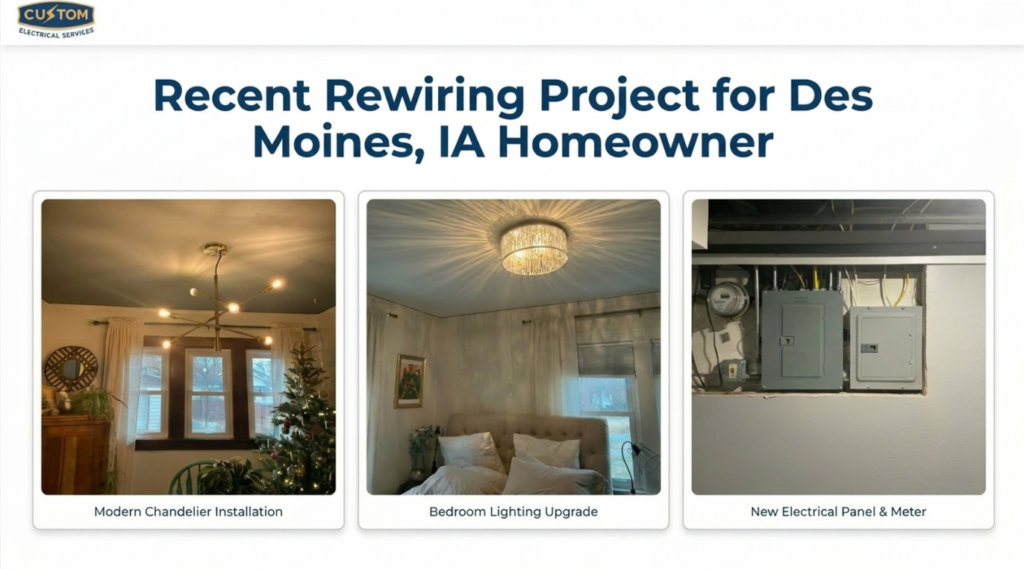
Custom Electrical serves Central and Eastern Iowa homeowners with a straightforward commitment: transparent pricing, clean workmanship, and electrical systems built to last well past 2026.
If you have questions about your home’s current electrical capacity or want a rewiring quote for your property, call our electricians now at (515) 669-3418 orschedule your rewiring quote online.